
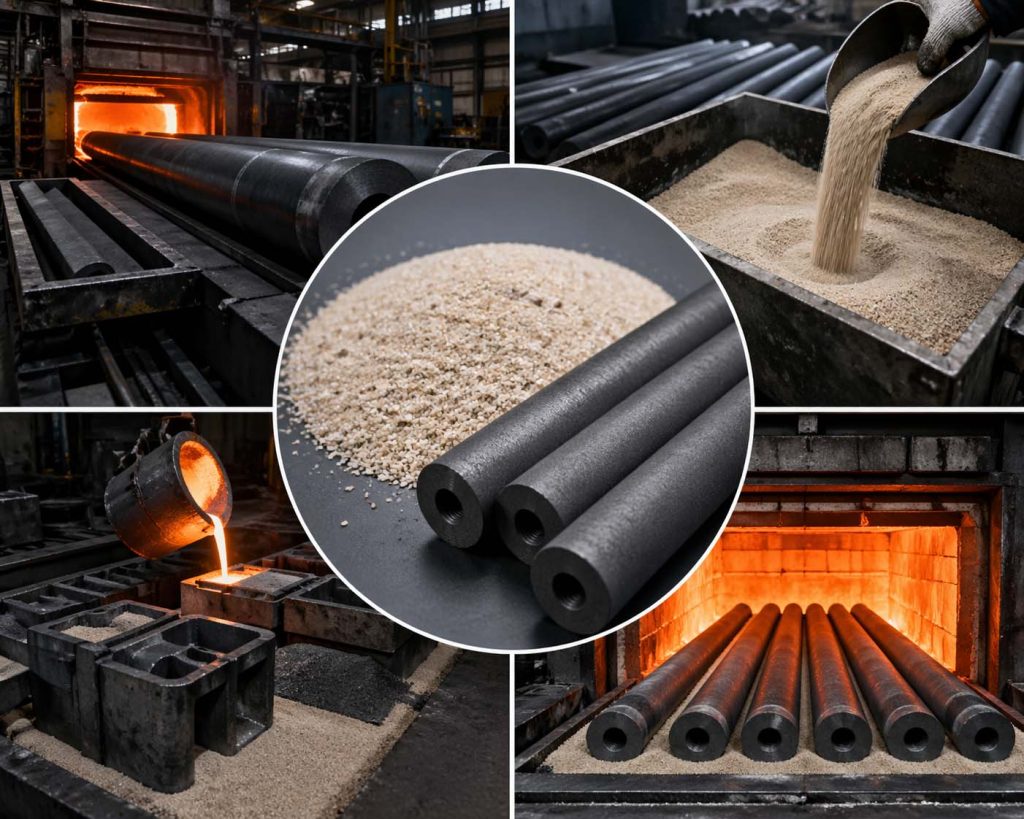
Graphite rods are widely used in furnaces, electrical discharge machining (EDM), batteries, electrodes, and metallurgical processes due to their excellent thermal conductivity, electrical conductivity, and resistance to high temperatures.
While graphite (carbon) is the primary raw material, silica sand (SiO₂) plays an important supporting and process-enhancing role in graphite rod manufacturing. Its unique properties—such as high melting point, chemical stability, and hardness—make it highly valuable across different stages of production.
Graphite Rod Manufacturing – A Quick Overview
The manufacturing of graphite rods involves several key steps:
- Raw material mixing (petroleum coke, pitch, additives)
- Forming / extrusion or pressing
- Baking at high temperatures
- Graphitization (2500°C–3000°C)
- Finishing and machining
In these stages, silica sand is not the main ingredient but plays a critical auxiliary role.
Key Uses of Silica Sand in Graphite Rod Manufacturing
1. Refractory Linings for Furnaces
Graphite rods are produced under extremely high temperatures. Silica sand is used in:
- Furnace linings
- Kiln insulation materials
- Refractory bricks and castables
👉 Benefits:
- Withstands extreme heat without deformation
- Provides thermal insulation
- Improves furnace life and efficiency
2. Mold & Support Bed Material During Baking
During baking, graphite rods are often placed in sand beds made of silica sand.
👉 Role:
- Provides uniform heat distribution
- Prevents deformation of rods
- Protects rods from direct flame exposure
This ensures dimensional stability and product quality.
3. Casting & Foundry Support for Graphite Components
Silica sand is used in casting molds where graphite components or parts related to rod manufacturing are produced.
👉 Advantages:
- High strength and permeability
- Smooth surface finish
- Ability to handle thermal shocks
4. Filler & Additive in Specialized Graphite Products
In certain advanced or cost-optimized graphite products:
- Silica sand acts as a filler material
- Helps control density and structure
- Enhances mechanical strength in composite applications
Although limited in direct graphite rod composition, its role is important in auxiliary graphite products and tooling.
5. Surface Treatment & Finishing Processes
Silica sand is used for:
- Cleaning graphite rods
- Surface preparation
- Removing impurities or residues
👉 Combined with graphite lubrication systems, it ensures:
- Smooth finishing
- Better performance of rods in applications
Why Silica Sand is Important for Graphite Rod Industry
Silica sand is preferred because of:
- High purity (SiO₂ content up to 99%)
- Thermal resistance (suitable for >1500°C environments)
- Chemical inertness with carbon materials
- Uniform grain size for consistent performance
- Cost-effectiveness in industrial applications
These properties make it an indispensable support material in graphite rod manufacturing.
SHREE GANESH MINERALS TRADE (Last 8 Years)
Over the past 8 years, Shree Ganesh Minerals Trade has established itself as a reliable supplier of premium-grade silica sand to graphite rod and related industries.
Supply Strengths:
- Consistent delivery of high-purity silica sand with controlled particle size
- Low iron content suitable for high-temperature graphite applications
- Custom grading for:
- Graphite rod manufacturers
- Refractory units
- Foundry and casting industries
Industry Contribution:
- Supporting stable furnace performance
- Enhancing product quality in graphite rod manufacturing
- Building long-term industrial partnerships
👉 With continuous growth and industry trust, Shree Ganesh Minerals Trade remains committed to supplying quality silica sand solutions for the evolving graphite industry.
CONTACT:
SHREE GANESH MINERALS TRADECALL/WHATSAPP: +91 99099 03579
E-MAIL: ravipatel@sgmt.in
WEB: www.sgmt.in